
Take, eat. This is my body. Matthew 26:26 (NIV)
Take and Eat, This is My Body – Hunger Series – Part 6
Go to PART 1 | PART 2 | PART 3 | PART 4 | PART 5 | PART 6 | PART 7
I've always loved Paul’s letter to his friends in Philippa, especially chapter three. Paul’s passion all but leaps off the page. You can feel it, sense it, through the ink, that despite all that Paul had been through, he was hungry for more.
“Compared to the high privilege of knowing Christ Jesus as my Master, firsthand, everything I once thought I had going for me is insignificant—dog dung. I’ve dumped it all in the trash so that I could embrace Christ and be embraced by him. I didn’t want some petty, inferior brand of righteousness that comes from keeping a list of rules when I could get the robust kind that comes from trusting Christ—God’s righteousness.” (Phil 3:7-9 MSG.)
Remember (from Part 2) that for the ancient Hebrews righteousness wasn’t something you achieved, but something you entered into. For those in Jesus time, to be in the righteousness of God meant to be anchored within God’s own aliveness. Not the “inferior brand” of keeping a list of rules, but being connected to the divine. Spirit to Spirit. A holy mix of divinity and humanity.
How did Paul stay hungry? How did he keep that fervor alive? He went on to say in chapter three that he kept pushing into what God had for him, he strived for it, leaned into it, actively put everything in his way aside so that he could continue to reach for it.
Now look, I don’t for one second think that Paul was perfect. If Netflix existed in his day, I’m sure he would’ve spent time binging on the couch in the name of “soul care.” But he did work to stay hungry, to keep that edge and drive.
What happens when you eat? Your body turns the food into fuel and spends the energy created by it. What you put into it gets used up, and eventually, you need to eat again.
How do you stay hungry and content?
Only take what you need – this is contentment. Use it well, spend it wisely. Sow it into the world around you: your body, your family, your friends, your community. Then come back to the table with a healthy appetite.
When aboriginal communities would hunt, they never went to the point of excess. They only took what they needed. And they were grateful for it. How do you stay hungry? Just take what you need. Over-consumption breeds greed and comparison and competition and gluttony. It disrespects resources and doesn’t think about whether there’s enough for everyone.
Take what you need.
Be grateful.
Spend the energy.
Come back to the table empty and ready to eat.
After all, we are filled to be emptied.
While eating what would be the final meal with his friends before he was murdered, Jesus said:
“Take (the bread), eat. This is my body.”
Taking the cup and thanking God, he gave it to them:
“Drink this, all of you. This is my blood, God’s new covenant poured out for many people for the forgiveness of sins.” (Matt 26:26-28).
What they ate and drank was to be used up and poured out. That’s how hunger works. You eat, you’re filled. You empty, you get hungry again. You come back to the table for more.
St Augustine said that “Christ is the bread, awaiting hunger.”
Tikkun Olam is Hebrew for “world repair.” Jesus method of repairing a broken world started with hunger and food. Tables and chairs, hearts and lives. Emptiness being filled then poured out into the hard work of love and grace, and the invitation to return to be filled once more.
World repair might just be found in the simple act of finding your own aliveness in the center of God’s own aliveness, spending the fullness found in that place in your life and relationships, and returning for more.
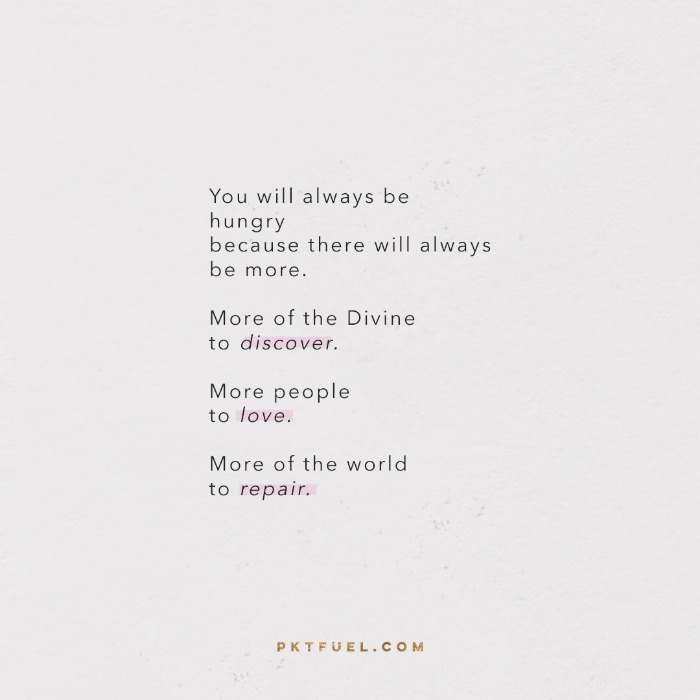
You will always be hungry because there will always be more.
More of the Divine to discover.
More people to love.
More of the world to repair.
Go to Part 7 – Stay Hungry, Stay Foolish »
Written by Liz Milani