

But he refused. Instead, he went off and had the man thrown into prison until he could pay the debt. Matthew 18:30 (TPT)
Unjust Servant – Forgive Series – Part 5
Go to PART 1 | PART 2 | PART 3 | PART 4 | PART 5 | PART 6
“But when that servant went out, he found one of his fellow servants who owed him a hundred silver coins. He grabbed him and began to choke him. “Pay back what you owe me!” he demanded. His fellow servant fell to his knees and begged him, “Be patient with me, and I will pay it back.” But he refused. Instead, he went off and had the man thrown into prison until he could pay the debt.” Matthew 18:28-30 (NIV)
The servant who had been forgiven a 2.5 billion dollar debt – and unpayable debt unbelievably and generously forgiven – could not bring himself to forgive little. He was owed a hundred silver coins by one of his friends, about four thousand dollars, and demanded the friend pay him back.
That’s not the only crazy part of this story: not only did the unjust servant fail to release his friend from his debt, but he also used violence and aggression to manipulate and overpower him. This guy was forgiven a 2.5 billion dollar debt, and he couldn’t give his friend, who only owed him $4000, the same grace. He forcefully grabbed his fellow servant by the neck, pushed him up against a wall. The heat of violence drew sweat from his brow and drove spittle from his mouth, that splashed out across the compact, aggressive space and onto the man in debt just $4000.
There’s a huge issue in our culture around entitlement. There are two kinds: the good kind that encourages you to respect yourself, stay safe, be protected, and reach out and help others. We are all entitled to love and belonging. But then there’s this other kind of entitlement which twists self-respect into arrogance. On the one hand, it will accept the charity of some while with the contrary, withhold that same charity from others.
Had the Unjust Servant allowed himself to experience the king’s act of mercy entirely, it would have led to gratitude. The work of forgiveness doesn’t end when it’s received. For it to be experienced fully, gratitude must be the response of the recipient. Otherwise, the work is only half done. Repentance is key to our relationship with God, not because he needs it, but because we do. It’s the act of owning what we have done and receiving the gift of grace extended to us. Gratitude draws forgiveness deep into our souls and changes our perspective, it becomes the sweetest blessing. If we don’t respond to forgiveness with deep gratitude, we disconnect ourselves from it. When faced with a situation where we COULD extend mercy to others, we can’t see past what is owed us because we’ve lost sight of the extravagant gift we have received.
This disconnect breeds aggression, violence, and rage. These things tell us that a person’s response to forgiveness has been shame, rather than gratitude. Shame that they couldn’t repay their debt. Shame that they needed forgiveness and mercy. Shame that they appeared weak and vulnerable. Pride in full force.
In Jesus parable, when the king heard what his forgiven servant had done to another who was in debt, “he handed him over to the jailers to be tortured until he should pay back all he owed. This is how my heavenly Father will treat each of you unless you forgive your brother or sister from your heart.”
The prison of shame is sheer torture. Self-righteous entitlement is a sinister and dangerous foe. It will hold us captive, treat forgiveness like it means nothing, and keep gratitude far from our hearts.
When we freely embrace forgiveness and draw it deep into our being with gratitude and joy, it changes the way we see others and the world.
The injustice of the Unjust Servant began not when he took his friend by the throat, but when he took the king’s gift and threw it away.
Don’t throw it away…
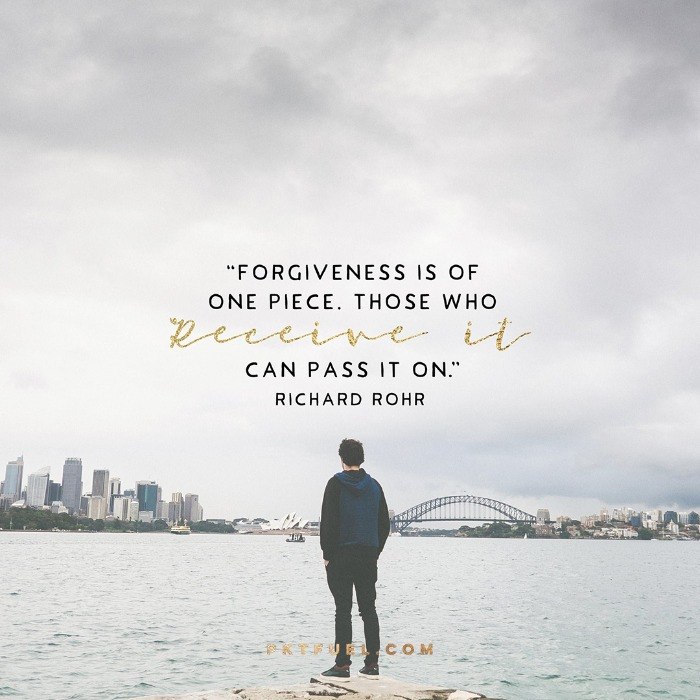
“Forgiveness is of one piece. Those who give it can also receive it. Those who receive it can pass forgiveness on. You are a conduit, and your only job is not to stop the flow. What comes around will also go around. The art of letting go is really the secret of happiness and freedom.” – Richard Rohr.
Has entitlement stifled your opportunity to receive forgiveness? Leave us your comments below.
Go to Part 6 – The Pain »
[vcex_image_grid columns=”3″ pagination=”false” thumbnail_link=”custom_link” link_title_tag=”true” custom_links_target=”_blank” overlay_style=”title-category-visible” columns_gap=”5″ img_hover_style=”fade-out” image_ids=”20934,20935,20937″ custom_links=”https://itunes.apple.com/app/apple-store/id1239768002?pt=118656308&ct=blog%20footer&mt=8,https://www.pktfuel.com/dailyemail,https://www.pktfuel.com/support” img_height=”350″]
Oof this is hard. Because no one wants to be the man who can’t forgive right?
But sometimes that man is you & your shame will hold you back from the truth of Christ’s forgiveness.
I once used my parents money
(freely given) to buy drugs. I took drugs on credit when I knew I would owe for ages. In some ways I have made reparations
but with my elderly mother Christ has given me the chance
to tend to her respectfully and be
the “generous” & dutiful
daughter who may also now
witness to the saving grace of
Christ. The thing is, I received
abuse at the hands of my mother
& father. Unintended, but abuse
nonetheless. This morning I
thought “was I the ungrateful
servant” because the deep hurt &
shame was once soothed by
self medication. Huh. In Christ I
have been forgiven & now can be free of shame. And drugs.
You are an inspiration to us Janet! (and I’m sure to many more!)
Much love
Jesse
What would be the difference when you forgive but you don’t forget is that part of repentance or is it just as bad as not forgiving wholeheartedly?
Good question Hardy! We discuss in Part 6 (the next one after this) that forgiveness does not always equal trust. Check it out and let us know your thoughts…
Cheers
Jesse (and Lizzy)