
I tell you that this man, rather than the other, went home justified before God. Luke 18:14 (NLT)
Moral Precepts – Us vs Them Series – Part 5
Go to PART 1 | PART 2 | PART 3 | PART 4 | PART 5 | PART 6
A WORD ON PARABLES:
Parables are interesting. It seems that we’ve (collectively) done our best to water them down, make them palatable, relatable and succinct. We’ve unknowingly stolen their original purpose from them. They’re not a moral tale where 2 + 2 = 4. “If you do this, that will happen.” Nope. That's not a parable. That's just a straightforward (boring) story. Parables are tales where 2 + 2 can end up equalling 43. The tension resides in that equal sign. How did that simple equation transform into something unexpected?
How do you explain the unexplainable? How do you put into words the unattainable? How do you express the holy and the sacred? The miraculous nature of the Divine that cannot be held with the limitations of human language and consciousness?
I think “story” is still so crucial and powerful in our cultures and societies because we are yet to encapsulate the transformations of the human spirit and the definition of the reality that sits just beyond the reach of this one, in mere words.
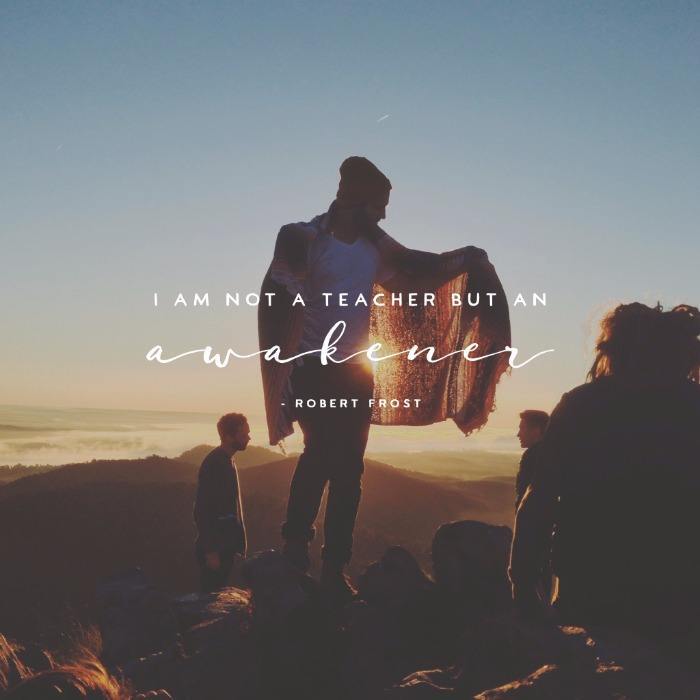
American Poet Robert Frost said, “I am not a teacher, but an awakener.”
Screenwriter Dudley Nichols said, “Jesus of Nazareth could have chosen simply to express Himself in moral precepts; but as a great poet he chose the form of the parable, wonderful short stories that entertained and clothed the moral precept in an eternal form. It is not sufficient to catch man’s mind, you must also catch the imaginative faculties of his mind.”
In his book, “The Orthodox Heretic,” Peter Rollins says, “Our religious world is awash with a vast sea of writing and talks designed to make the truth of faith clear, concise, and palatable… Parables subvert this desire to make faith simple and understandable. They do not offer the reader clarity, for they refuse to be captured in the net of a single interpretation and instead demand our eternal return to their words, our wrestling with them, and our puzzling over them… [they] have less to do with fixing meaning than rendering meaning fluid and affective.”
Jesus was a great teacher, but he is also a grand awakener. One-third of his recorded conversations, whether spoken with a few or with many, are parables. Jesus was asked many questions and was often challenged to ‘lay down the law’ and give ‘black and white’ instruction on life and living. He had many opportunities to “express himself in moral precepts,” to rattle off dot points of “how to’s” for following his New Way. But instead, he responded to most questions in parables; prophetic poetry used to move us beyond logic and reason, designed to wake up the heart and imagination, taking us to the deep end of life where nothing is certain and faith is truly, well, faith.
Parables in our ears are like yeast is in bread. They enter our ears and minds sounding like any other story or moment. But there’s something about them that stirs into our souls and activates with the heat of life. Parables rise and expand within us pushing our boundaries and challenging our world views and convictions.
These days, I struggle with the way we view the Bible. Rigid and rules and lines and truth and black and white. We engage it like we would a recipe book: if I take salvation, add a dash of striving to be good, and maybe a pinch of prayer, I’ll get Christ in my heart and heaven at the end.
But when you read the stories within it as you would a parable, dare I say even a novel, a film: when you read these rich, messy, crazy stories, you realise that there are very little black and white moments contained in the Bible and tonnes of situations where 2 + 2 = everything other than 4. When you throw the “Bible is like a recipe/rule book” out the window, you'll start to see the miraculous life contained in the words, and beyond them, of that sacred and holy text.
Next time you read parables (and the scriptures), do it with wide-eyed wonder. Turn on your imagination and allow the greatest story-teller in the universe to awaken within you things that have slept far too long.
Over to you.
What have parable has awakened you? Leave us a comment below.
Go to Part 6 – Versus »
[vcex_image_grid columns=”3″ pagination=”false” thumbnail_link=”custom_link” link_title_tag=”true” custom_links_target=”_blank” overlay_style=”title-category-visible” columns_gap=”5″ img_hover_style=”fade-out” image_ids=”20934,20935,20937″ custom_links=”https://itunes.apple.com/app/apple-store/id1239768002?pt=118656308&ct=blog%20footer&mt=8,https://www.pktfuel.com/dailyemail,https://www.pktfuel.com/support” img_height=”350″]